IN Brief:
- The 550SV backhoe enters Europe’s sub-80hp class with a 55kW Stage V diesel engine and front-loader/rear-excavator layout.
- The electric TL100EV has a 23.5kWh lithium iron phosphate battery and 469kg rated operating capacity; its 1.3-tonne tipping load is not a payload rating.
- The 221G and 321G are existing compact wheel loaders receiving revised cabs and operator-control functions, not newly launched models.
CASE Construction Equipment has introduced two different compact machines to its European offering — the 550SV backhoe loader and the battery-electric TL100EV mini track loader — while separately updating the established 221G and 321G compact wheel loaders. The 550SV is intended for digging and loading duties, the TL100EV for compact tracked material handling, and the wheel loader revisions concern operator facilities and control functions rather than new model launches.
The 550SV takes CASE into the European backhoe loader segment below 80hp. Its 2.8-litre, four-cylinder diesel engine delivers approximately 55kW, or 74hp, and meets EU Stage V emissions requirements using a diesel oxidation catalyst and particulate filter. The specified after-treatment arrangement does not use selective catalytic reduction or AdBlue, although filter maintenance and normal diesel-engine servicing remain part of the machine’s operation.
A backhoe loader combines a front loading system with a rear excavating attachment, allowing the same machine to move material, handle pallets with appropriate equipment and excavate trenches or foundations. On the 550SV, the rear dipper can be extended and its inline cylinder arrangement is intended to improve visibility along the digging assembly. The front loader incorporates mechanical parallel lift, which helps control attachment attitude as the loader arms move through their travel.
CASE also specifies load-sensing hydraulics, a Powershuttle transmission and optional Ride Control for the model. Load-sensing systems adjust hydraulic delivery in response to operating demand rather than maintaining a fixed high flow at every moment. That can reduce unnecessary hydraulic power consumption, although operating efficiency still depends on duty cycle, attachment selection and how the machine is used. Ride Control is intended to manage pitching during travel with material in the bucket, rather than alter the machine’s basic lifting rating.
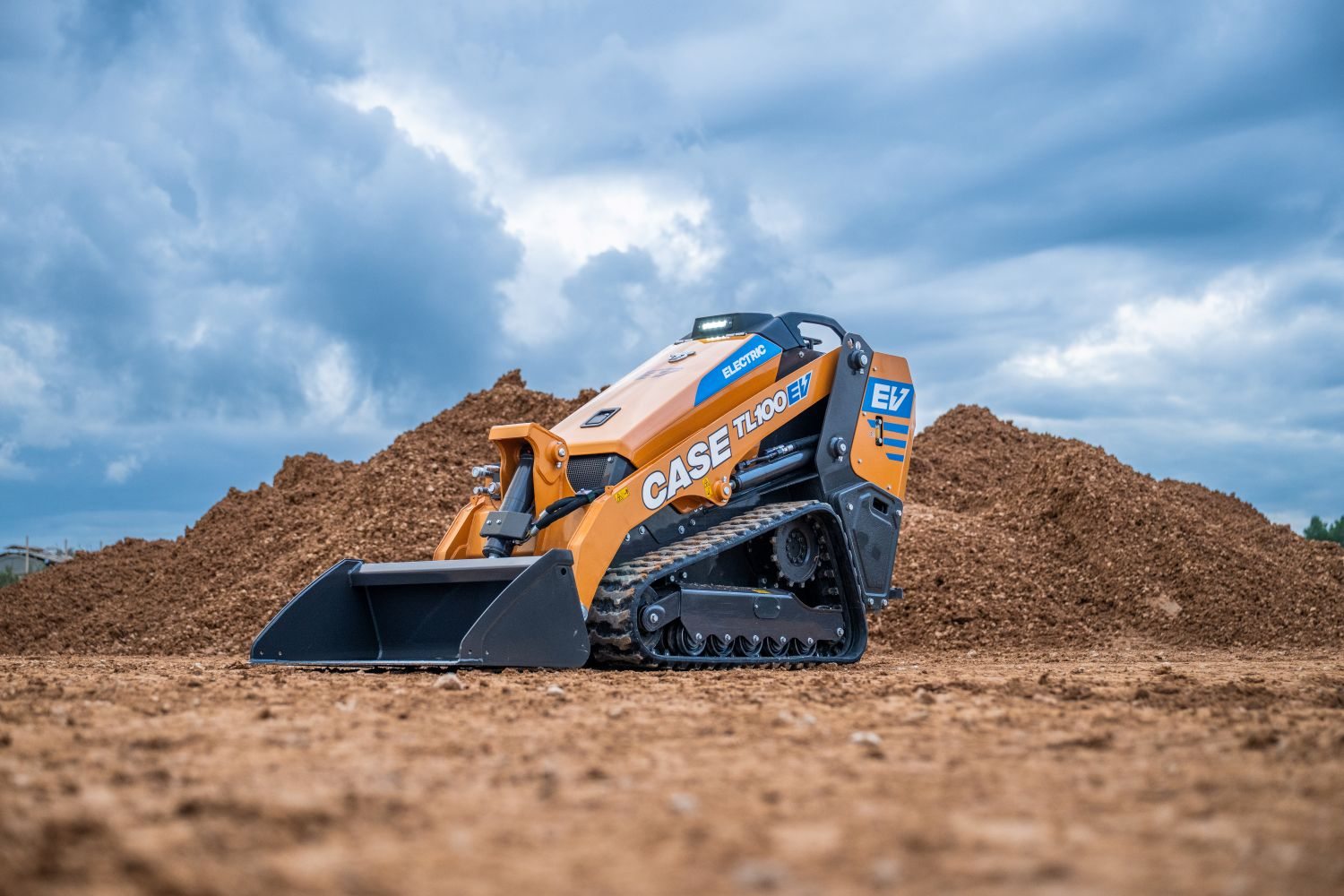
The separate TL100EV is a compact tracked loader with a stand-on operator position and a 23.5kWh lithium iron phosphate battery. CASE’s UK specification gives its rated operating capacity as 469kg. Trade specifications also report a tipping load of approximately 1.3 tonnes: tipping load describes a stability threshold under defined test conditions, whereas rated operating capacity is the manufacturer’s lower working-load figure. The 1.3-tonne figure must not be treated as a safe working payload.
Three electric motors divide the TL100EV’s duties, with two motors driving the tracks and another supplying the hydraulic system. This differs from the diesel engine and transmission architecture of the 550SV. Travelling and lifting can place different demands on the battery, so practical runtime will depend on ground conditions, attachment use and duty cycle; a single duration should not be assumed for every operation.
The lack of a diesel exhaust at the machine is useful where ventilation is constrained or local emissions restrictions apply. Electric drive also changes the acoustic characteristics of some tasks, though attachments, tracks, hydraulics and the surrounding work can still generate substantial noise. Charging arrangements, access to suitable power and actual energy use remain practical limits on deployment. The TL100EV therefore complements rather than directly replaces the diesel backhoe in the published range.
The TL100EV belongs to the mini track loader family and can be paired with approved attachments for tasks including loading, sweeping and augering, within the machine’s operating limits. A tipping-load figure alone cannot be used to select an attachment or determine working capacity. Ground conditions, slope, counterweights, load position and the manufacturer’s rated operating figure remain central to safe deployment.
The 221G and 321G developments concern machines that were already in the compact wheel loader range. CASE is adding a revised Deluxe cab, improved visibility and ergonomics, configurable loader-arm and bucket response, ECO mode, cruise control and automated loading functions. These features affect how operators control repeated loading and travelling cycles; they do not make the 221G and 321G newly launched models or variants of the TL100EV.
Operator controls can affect consistency when the loader performs frequent short movements between stockpiles, vehicles and working areas. Adjusting lift and bucket response lets the driver match the machine to the material and task, while cruise control is intended for appropriate travel operations. The available information does not substantiate a quantified productivity or fuel-saving percentage for the upgrades, and such savings should not be assumed from the presence of an ECO setting alone.
CASE lists a 0.9–1.2 cubic metre bucket volume range for the 221G and a 1.0–1.3 cubic metre range for the 321G, depending on configuration. Both remain in the compact wheel loader category, serving loading and material movement rather than the trench excavation undertaken by the rear equipment of the 550SV. They also differ from the TL100EV in operator accommodation, travel characteristics and suitable work areas.
The two newly introduced machines and the revised wheel loaders occupy different roles: a diesel backhoe for combined digging and front loading, an electric mini track loader for restricted access and material handling, and two established wheeled models with revised cabs and controls. Selection still depends on load rating, ground conditions, attachments, charging provision and working space. CASE has not confirmed a common UK delivery date for all four product developments.