IN Brief:
- ACT was used to manufacture two types of full-scale precast wall element.
- The trial took place under normal operating conditions at C-concrete.
- A life-cycle assessment recorded a 67.5% lower carbon footprint.
Ecocem has completed an industrial-scale trial of its ACT low-carbon cement in full-size precast wall elements at C-concrete’s factory near Antwerp.
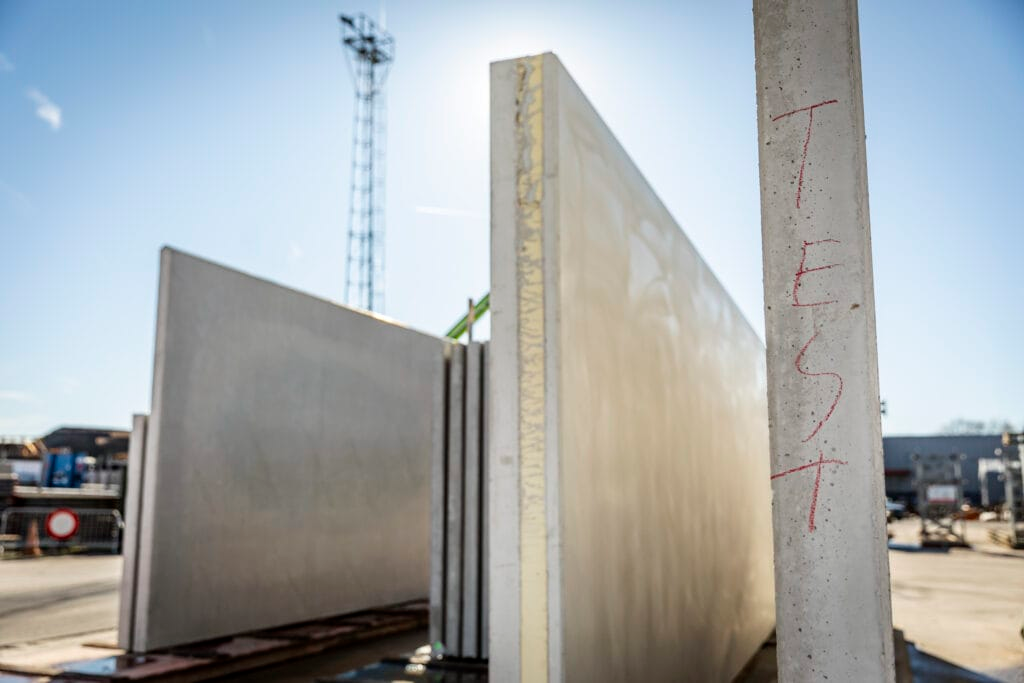
The programme produced a 10m by 3m fire-resistant wall and an 8m by 3m insulated sandwich wall under normal factory conditions. C-concrete used its established batching, casting, curing, and demoulding processes rather than creating a separate pilot production line.
A life-cycle assessment carried out by the precast manufacturer recorded a 67.5% reduction in the carbon footprint of the concrete elements compared with an equivalent product made using conventional cement.
ACT is designed to replace up to 70% of clinker with supplementary cementitious materials and limestone filler. Ecocem says the technology can reduce cement-related emissions by up to 70% while retaining the strength and durability required for structural applications.
Precast production provides a demanding test for alternative binders because factories depend on predictable early strength. Elements must reach sufficient capacity to be removed from moulds, handled, stored, and transported within tightly controlled production cycles.
A material that performs adequately at 28 days but delays demoulding by several hours can reduce factory output or require additional moulds and floor space. The ability to use ACT without fundamental changes to C-concrete’s process is therefore central to the commercial assessment.
Low-carbon cement must match factory production cycles
Cement remains difficult to decarbonise because process emissions are released when limestone is converted into clinker, independently of the fuel used to heat the kiln. Reducing fossil energy lowers one part of the footprint, but deeper cuts require less clinker, carbon capture, or alternative chemistry.
Supplementary cementitious materials have long replaced a proportion of clinker, although securing sufficient quantities and maintaining consistent performance are becoming more difficult as traditional sources such as coal-fired power-station ash decline.
Technologies combining several mineral components may provide a broader raw-material base, but they must still meet standards and project specifications. Strength development, workability, curing, durability, fire performance, and reinforcement protection all need to remain predictable across changing production conditions.
The UK concrete sector has already set out a wider circular-economy programme covering design, manufacture, use, recovery, and reuse. Lower-carbon binders form one part of that transition alongside material efficiency, longer service life, recycled aggregates, adaptable design, and improved recovery at demolition.
Precast factories offer a controlled route to scale because moisture, temperature, batching accuracy, compaction, curing, and testing can be managed more consistently than on exposed construction sites. Repetition also allows manufacturers to collect performance data across large numbers of elements.
Adoption will still depend on certification, insurance, specification, availability, and price. Structural designers require reliable information on strength development, creep, shrinkage, fire resistance, reinforcement protection, and durability, while contractors and clients need confidence that supply will remain available throughout the project.
Environmental claims will increasingly be tested through product-specific declarations rather than broad cement averages. The reported 67.5% reduction is substantial, although comparisons must use consistent boundaries, mix designs, transport assumptions, and service-life expectations.
The construction industry is moving towards more detailed carbon measurement because apparently similar products can perform very differently under changing assumptions. A binder with a lower factory footprint may also affect curing energy, transport, reinforcement quantities, or element thickness, all of which influence the completed product.
Ecocem is constructing a dedicated ACT facility in Dunkirk with planned annual capacity of around 300,000 tonnes. Commercial production is expected to begin during 2026 as part of a wider investment programme intended to expand the technology through the end of the decade.
The trial moves ACT beyond laboratory testing and small demonstration pours. Further adoption will depend on repeatable commercial production across different factories, element types, reinforcement arrangements, and curing regimes.
Low-carbon cement will displace conventional products at scale only where it can match construction programmes, quality controls, and long-term structural performance as reliably as it meets the carbon calculation.