IN Brief:
- HG Construction has been appointed to two Fusion Group student schemes totalling 1,247 beds.
- The Cardiff project will provide 706 beds across 17 storeys at Longcross Court.
- Loughborough will gain 541 beds through redevelopment of a brownfield site beside the Grand Union Canal Basin.
HG Construction has been appointed by Fusion Group to deliver two purpose-built student accommodation schemes in Cardiff and Loughborough, adding 1,247 beds to the contractor’s expanding national workload.
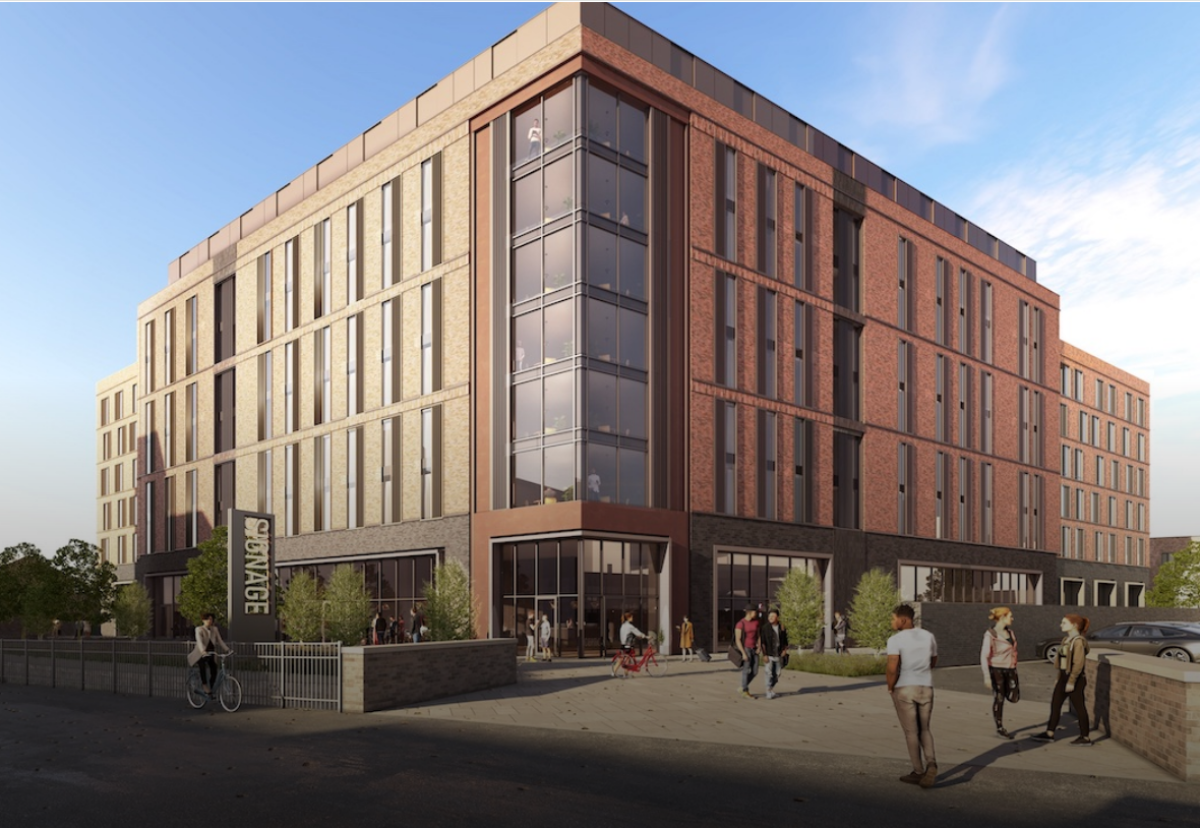
The larger development will provide 706 beds at Longcross Court in Cardiff, where a prominent city-centre site is planned to accommodate a 17-storey building. In Loughborough, the contractor will deliver 541 beds across an eight-storey scheme beside the Grand Union Canal Basin.
Fusion’s Loughborough project will regenerate a derelict brownfield plot with student rooms, shared amenities, a landscaped courtyard, and garden space. Its canalside position creates a sensitive boundary for logistics, temporary works, access, drainage, and the treatment of public-facing elevations.
The Cardiff scheme combines greater height with the constraints of an urban location, requiring coordinated deliveries, vertical logistics, façade installation, and building-services distribution across 17 storeys. Longcross Court is intended to create a high-density residential building close to established transport and education infrastructure.
Both appointments continue HG Construction’s expansion beyond its traditional London and South East base. The contractor is now delivering projects in more than ten towns and cities, including Leeds, Manchester, Bristol, and Birmingham, as it increases its exposure to student and residential work across regional markets.
HG and Fusion are already working together on a 622-bed scheme on Bristol Road in Birmingham. That development topped out in February 2026 and is due to complete in summer 2027, giving the project teams an established delivery relationship before work advances in Cardiff and Loughborough.
Repeat appointments can reduce the time needed to align design standards, reporting procedures, room specifications, procurement strategies, and quality expectations. Student accommodation uses highly repetitive layouts, but the benefits of repetition depend on early coordination and disciplined control of changes across bedrooms, corridors, kitchens, common areas, and service risers.
Bathroom pods, preassembled service modules, panelised façades, and standardised room components can shorten programmes and reduce on-site labour where the design is fixed early enough. Any variation introduced after manufacturing begins can multiply quickly across hundreds of rooms, increasing rework and disrupting installation sequences.
The two schemes arrive within a student housing market that continues to attract institutional capital, despite wider pressure on development finance. Demand remains concentrated in university cities where existing accommodation is limited, older stock no longer meets expectations, or student numbers have outgrown the available purpose-built supply.
PBSA schemes can offer a more defined operational model than speculative private housing because rents, room types, and annual occupancy cycles are assessed at building level. They nevertheless face the same pressures around borrowing costs, planning, building regulations, utility capacity, land values, and construction inflation.
Programme certainty is particularly important because the sector works towards fixed academic-year openings. Missing a September intake can delay meaningful occupation for months, leaving the owner with an incomplete income year and creating pressure to accelerate commissioning, snagging, and handover.
Contractors therefore need to protect the closing stages of the programme long before fit-out begins. Permanent power, water, lifts, fire systems, controls, communications, and statutory approvals must be sequenced around room completion, while operator training and resident-management systems need sufficient time before occupation.
Higher-rise student buildings also carry more extensive fire and life-safety requirements, including coordinated compartmentation, smoke control, evacuation strategies, façade performance, fire-stopping records, and the management of design information through the building-control process. Quality assurance must follow repetitive work without assuming that repetition automatically produces consistency.
Digital inspection systems are increasingly used to record installations room by room and package by package. Photographic evidence, location-linked checks, and structured sign-off can give project teams a clearer record of concealed work, although the system must remain simple enough to be used consistently by supervisors and subcontractors.
Brownfield regeneration adds another layer to the Loughborough project, where ground conditions, historic uses, constrained access, and existing services can affect early works. The canal basin also raises questions around water protection, edge conditions, public access, and the coordination of landscape work with the main building programme.
Cardiff’s scale places greater emphasis on crane strategy, hoists, façade access, and the movement of materials through a restricted footprint. As the frame rises, productivity will depend on maintaining predictable floor cycles and ensuring that follow-on trades receive completed, dry, and properly surveyed work areas.
Regional expansion can diversify HG Construction’s pipeline, but it also requires dependable local subcontractor networks and management capacity. National standards must be balanced with regional labour markets, material supply, planning conditions, and logistics, particularly when several large schemes progress simultaneously.
The appointments give HG and Fusion the opportunity to apply lessons from Birmingham across two different site types: a tall city-centre building and a lower canalside brownfield development. Delivery will depend on how effectively the partners standardise repeatable elements while adapting structure, façade, logistics, and public realm to each location.
With 1,247 beds now added to their joint programme, the two companies are extending a relationship built around large, operationally time-sensitive residential schemes. The next milestones will centre on mobilisation, design coordination, and supply-chain appointments capable of supporting fixed completion dates across both cities.